The Trigger–Emotion–Reaction Loop: The Hidden Pattern Running Your Life
Feb 27, 2026
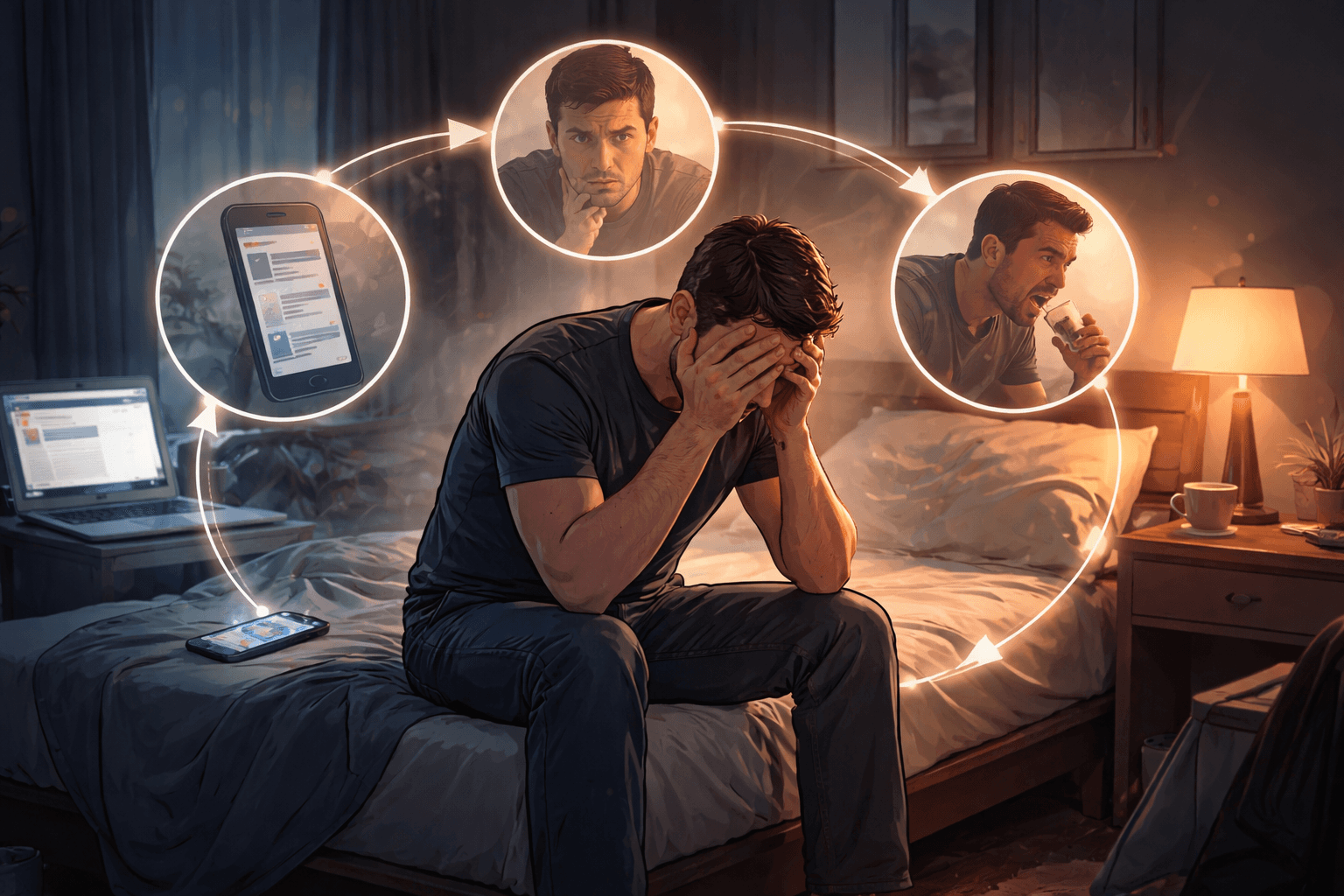
Your reactions aren’t a discipline problem, they follow a Trigger → Meaning → Reaction pattern.
The initial emotion (fear, anger, shame, sadness) is natural; the suffering comes from the story your mind adds.
Secondary reactions like rage, overthinking, shutdown, or overworking are attempts to escape discomfort.
Temporary relief reinforces the loop, which is why it keeps repeating.
You don’t break the pattern with willpower; you break it by building awareness and emotional capacity.
If you feel you keep repeating the same reactions; snapping, shutting down, overthinking, overworking, controlling, numbing, this isn’t a character flaw.
It’s not weakness. It’s not a lack of discipline, and it’s not a motivation problem.
It’s a pattern.
Once you can see the pattern clearly, you can finally change it.
The pattern looks like this:
Trigger → Emotion → Reaction
Most men try to fix the reaction with willpower.
But willpower doesn’t work here, because the reaction is happening beneath conscious choice.
Let’s break it down.
Step 1: It starts with a trigger
Something happens that activates your system.
Examples:
She doesn’t reply for hours.
Your boss makes a flippant comment about performance.
A client pulls out of a deal.
You get overlooked for a role.
A plan falls through.
A trigger is simply an event, external or internal, that lights the fuse.
The trigger isn’t the core issue.
It’s what comes next.
Step 2: Then comes the primary emotion (the clean part)
After the trigger, your nervous system produces a primary emotion:
Fear
Sadness
Anger
Shame
This part is clean. It’s your nervous system doing its job.
If someone you care about goes quiet and something in you tightens, if a financial setback hits and your chest constricts, that isn’t pathology or weakness.
That’s your system registering a potential threat.
So far, nothing is “wrong.”
The problem usually starts with the next step.
Step 3: Your mind assigns meaning (usually unconsciously)
This is the turning point. Your mind instantly, often without you noticing, adds a story to the feeling:
“She’s pulling away.”
“I’m failing.”
“They don’t respect me.”
“I’m not safe.”
“I don’t matter.”
That meaning feels like truth.
But it isn’t the truth.
It’s learned interpretation, a conditioned narrative layered over raw emotion.
It’s why two men can experience the same trigger:
One feels it… and moves forward.
The other spirals for days.
The difference isn’t toughness.
It’s the meaning they assigned.
Step 4: Secondary emotions escalate the system
Once meaning is assigned, the system intensifies.
This is where it escalates into:
Rage
Anxiety
Urgency
Numbness
Self-criticism
Most men think this is the real issue.
“I have an anger problem.”
“I overthink.”
“I sabotage.”
“I shut down.”
But those are downstream effects.
They’re responses to the story your mind generated about the original feeling.
Step 5: You react to escape discomfort (and it works… briefly)
Now you act, not from choice, but from the urge to escape what’s happening inside you.
You might:
Shut down mid-conversation
Overwork to prove your worth
Get controlling
Withdraw
People-please
Scroll and numb out
Lash out
Over analyse every detail
And here’s the part that traps you:
It works.
You get temporary relief.
And temporary relief teaches your nervous system:
“Do that again next time.”
This reinforcement is how the pattern gains strength.
So the full loop becomes:
Trigger → Meaning → Escalation → Action → Relief → Repeat
Over time, this stops feeling like a pattern.
It feels like “just who you are.”
But it isn’t your personality.
It’s conditioning.
How to break the loop (without more discipline)
You don’t break this with more willpower.
You break it with awareness and capacity.
1) Recognise the primary emotion early
Before the story. Before the reaction.
Ask: What am I actually feeling right now?
Fear? Shame? Sadness? Anger?
Name the raw emotion.
2) Identify the meaning your mind assigned
Not to argue with it. Just to see it.
For example:
“I’m telling myself this means I’m not respected.”
“I’m telling myself this means I’m failing.”
“I’m telling myself this means I don’t matter.”
That single step creates distance between you and the story.
3) Stay present without collapsing or reacting
Not suppressing.
Not exploding.
Not fixing.
Groundedness isn’t control.
It’s capacity.
The capacity to:
Feel without panicking
Pause without suppressing
Act from choice instead of defence
When you increase capacity, the pattern loosens its grip.
You see the story and you regain authorship.
Controlling outcomes versus training your system
This is the shift most men miss:
Trying to control outcomes keeps you stuck.
Training your system changes everything.
Because life will always provide triggers.
The win isn’t eliminating triggers.
The win is becoming the man who can feel the activation, without being dragged into the old loop.
Final thought
If your life keeps circling the same conflicts, the same shutdowns, the same spirals, the issue isn’t that you “need to try harder.”
It’s that you’ve been fighting a nervous system pattern with willpower, but that’s not how change works.
Awareness creates choice.
Capacity creates freedom.

You Don’t Need to Feel Calm to Act Calmly
Oct 9, 2026

Why Do I Procrastinate Even When I Have Time?
Oct 2, 2026

How to respond differently to stress and difficult emotions
Sep 25, 2026

Why You Keep Waiting to Feel Ready Before Taking Action
Sep 18, 2026