Why Overthinking Makes Anxiety Worse (and what to do instead)
Jul 10, 2026
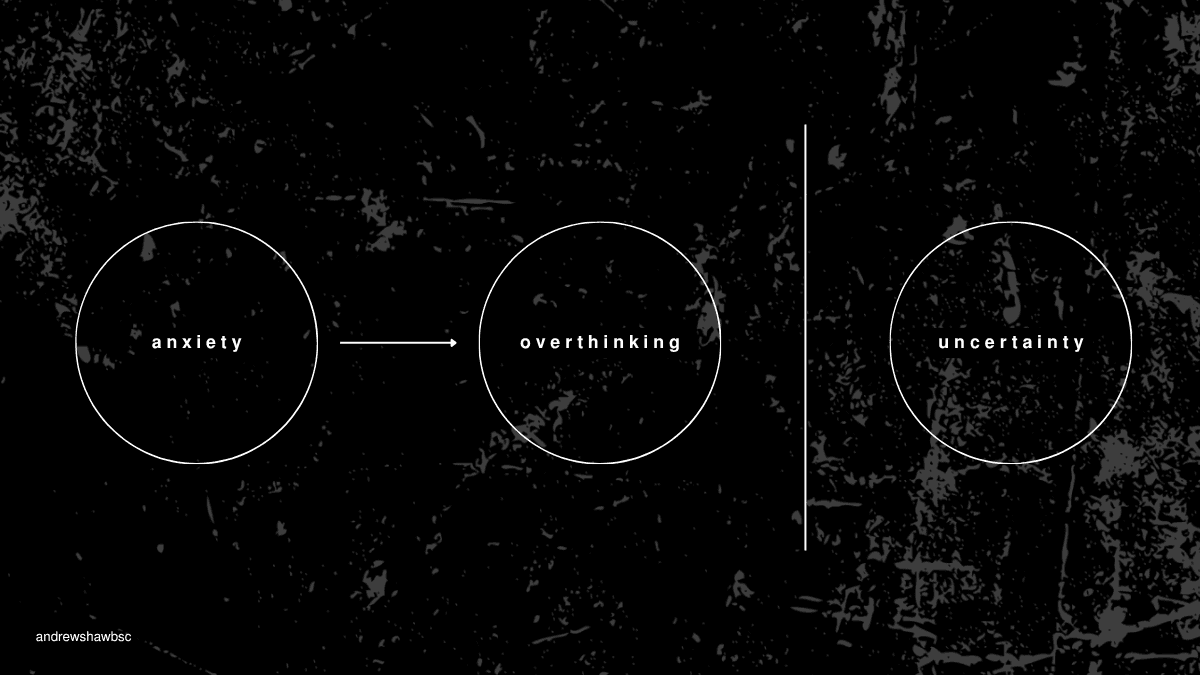
Anxiety isn't trying to harm you, it's trying to protect you by creating certainty.
Overthinking is a coping strategy, not the problem itself.
Endless thinking keeps you away from uncomfortable emotions like fear, shame, or uncertainty.
Instead of asking, "How do I stop thinking?" ask, "What feeling is my thinking trying to avoid?"
Freedom comes from learning to tolerate difficult emotions, not from eliminating anxious thoughts.
If you've ever struggled with anxiety, you've probably noticed something frustrating:
The more anxious you feel, the harder your mind works.
It searches for answers.
It replays conversations.
It analyses every possible outcome.
It imagines what you'll say next time.
It ruminates over what you should have said.
At first, it feels productive. It feels as though you're getting closer to the answer, closer to certainty, closer to finally feeling calm.
But despite all that thinking, nothing changes.
You don't feel better.
So your mind reaches a familiar conclusion:
"I just haven't thought about it enough."
And the cycle begins again.
Why Anxiety Leads to Overthinking
Many people believe anxiety itself is the problem.
Something to suppress.
Something to eliminate.
Something that's broken.
I see it differently.
Anxiety isn't trying to harm you. It's trying to protect you.
The problem isn't its intention. It's the strategy it uses.
Your brain operates on a simple assumption:
If I can predict every possibility, replay every mistake, and prepare for every outcome, I can stop something bad from happening.
From an evolutionary perspective, this makes sense. Our brains evolved to detect threats and anticipate danger. Unfortunately, modern anxiety often directs this same survival mechanism toward imagined future scenarios rather than immediate threats.
The intention is safety.
The strategy is endless thinking.
The Real Reason You Can't Stop Overthinking
Most people think they have an overthinking problem.
I don't believe they do.
Overthinking isn't random.
It's a coping strategy.
Your mind keeps analysing because it believes thinking will help you avoid experiencing something emotionally painful.
Fear.
Shame.
Rejection.
Regret.
Grief.
Loneliness.
If your mind can keep you busy solving tomorrow, perhaps you'll never have to fully experience what's happening today.
In that sense, overthinking isn't the problem.
It's the solution your brain has come up with.
Why Reassurance Never Lasts
This is why arguing with anxious thoughts rarely works.
Every answer creates another question.
Every reassurance creates another doubt.
Every attempt to find certainty simply teaches your brain that uncertainty is dangerous.
The relief you feel after reassuring yourself is usually temporary. Before long, another "what if?" appears, and the cycle starts again.
You're treating the symptom while missing its purpose.
How to Break the Cycle of Anxiety and Overthinking
The next time you notice yourself spiralling, resist the urge to ask:
"How do I stop thinking?"
Instead, ask yourself:
"What feeling is my thinking trying to protect me from?"
This question changes everything.
Instead of becoming absorbed in the content of your thoughts, you begin paying attention to the emotion underneath them.
Often, you'll discover that beneath the endless thinking is something much simpler:
A fear of failure.
A fear of rejection.
A fear of uncertainty.
A fear of not being enough.
These emotions are uncomfortable.
But they're also survivable.
Learning to Tolerate Uncomfortable Emotions
The goal isn't to enjoy uncomfortable emotions.
It's to become willing to experience them without immediately trying to escape.
Stay with the feeling.
Notice where it sits in your body.
Allow it to exist without rushing to solve it.
Every time you experience discomfort without reaching for overthinking, reassurance, avoidance, or distraction, you teach your nervous system something profoundly important:
You can survive the feeling.
Over time, your brain begins to learn that the emotion itself isn't dangerous.
And when the feeling no longer seems threatening, the need to overthink gradually loses its purpose.
Freedom Doesn't Come From Eliminating Anxiety
Many people spend years trying to get rid of anxiety before they'll allow themselves to live.
But freedom doesn't arrive when fear disappears.
It arrives when the avoidance of uncomfortable emotions no longer dictates your decisions.
Anxiety may still show up.
Difficult thoughts may still appear.
The difference is that they no longer control your behaviour.
That's where lasting change begins.
Final Thoughts
If anxiety has convinced you that thinking harder is the answer, remember this:
Your mind isn't trying to torture you.
It's trying to protect you.
But protection doesn't always require more thinking.
Sometimes it requires less avoidance.
The next time you catch yourself trapped in an endless loop of analysing, replaying, or worrying, pause and ask yourself:
What feeling am I trying not to experience right now?
You may find that the answer you've been searching for was never hidden in another thought.
It was waiting beneath them all.
Frequently Asked Questions
Is overthinking a symptom of anxiety?
Yes. Overthinking is a common response to anxiety. It often functions as an attempt to gain certainty, predict future outcomes, or avoid uncomfortable emotions.
Why can't I stop overthinking?
Because your brain believes thinking is keeping you safe. The more you seek certainty through analysis and reassurance, the more your mind learns that uncertainty is something to fear.
What's the best way to stop overthinking?
Rather than trying to force thoughts away, notice the emotion underneath them. Learning to tolerate feelings like fear, uncertainty, or shame often reduces the need to overthink in the first place.
Can anxiety ever go away completely?
Anxiety is a normal human emotion. The goal isn't to eliminate it, but to change your relationship with it so it no longer controls your behaviour or keeps you stuck in cycles of worry.

Why Do I Procrastinate Even When I Have Time?
Oct 2, 2026

How to respond differently to stress and difficult emotions
Sep 25, 2026

Why You Keep Waiting to Feel Ready Before Taking Action
Sep 18, 2026

High-Functioning Burnout: When Your Life Still Works but You’re Not Okay
Sep 11, 2026