why avoidance makes anxiety worse and keeps you stuck
May 29, 2026
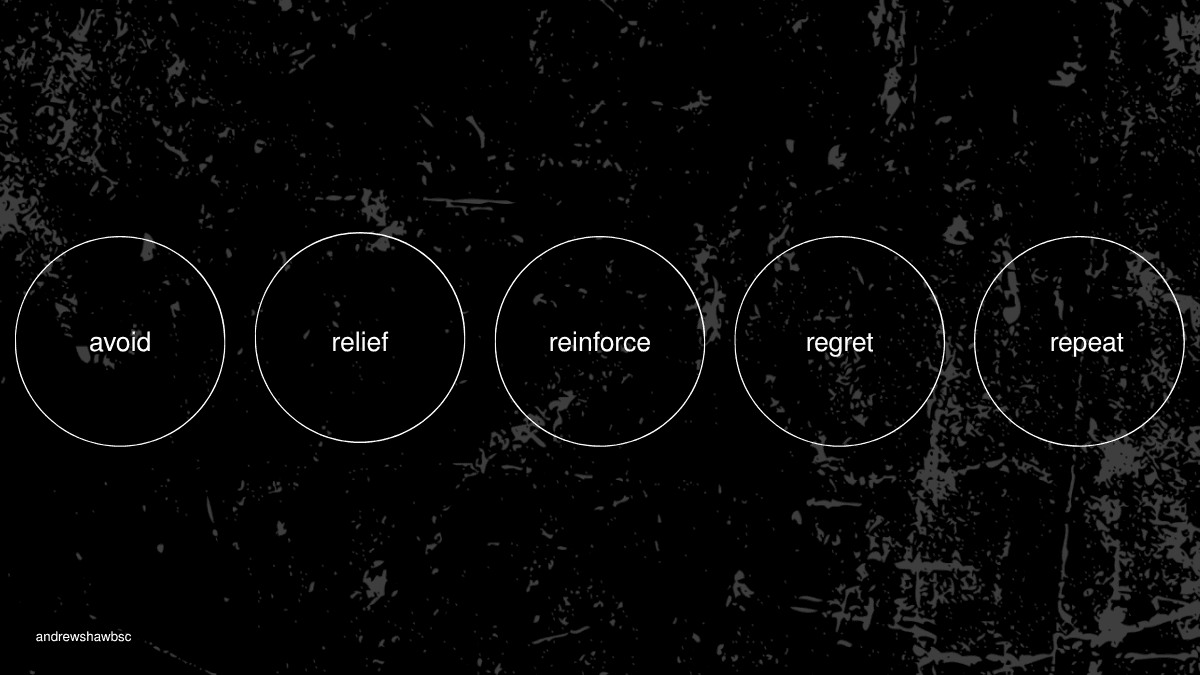
Most avoidance is not about the situation. It is about avoiding the feeling you predict the situation will create.
When you avoid, your brain experiences relief and learns that avoidance equals safety, making the pattern stronger.
Over time, avoided tasks, conversations, and decisions feel bigger because the prediction becomes more frightening than reality.
Confidence does not come from waiting until you feel ready. It comes from repeatedly acting while discomfort is present.
Every time you stay instead of avoid, your nervous system learns that discomfort is uncomfortable but not dangerous.
You know what you should do.
Make the call.
Have the conversation.
Send the email.
Exercise.
Eat healthy.
Set the boundary.
Tell someone you love them.
The intention is there.
You want to do it.
You know it would help.
Then the moment arrives.
Pressure surfaces.
Anxiety appears.
Your mind begins predicting what might happen.
Discomfort.
Rejection.
Conflict.
Failure.
Embarrassment.
Exhaustion.
Suddenly the task feels bigger than it did moments before.
You delay.
You cancel.
You distract yourself.
You shut down.
You avoid.
Most people assume this happens because they are lazy, unmotivated, or lacking discipline.
That is rarely the real problem.
The real issue is that your nervous system has confused discomfort with danger.
the psychology of avoidance
Avoidance is one of the most common responses to anxiety.
When your brain predicts an uncomfortable experience, it attempts to protect you by steering you away from it.
From an evolutionary perspective, this makes sense.
The brain is designed to keep you safe.
The problem is that it often treats emotional discomfort as if it were a genuine threat.
A difficult conversation feels dangerous.
Setting a boundary feels dangerous.
Taking a risk feels dangerous.
Speaking up feels dangerous.
The discomfort becomes interpreted as something that must be escaped.
As a result, avoidance feels like relief.
why avoidance makes anxiety stronger
The moment you avoid something, your anxiety temporarily decreases.
You feel better.
The pressure disappears.
The uncomfortable feeling fades.
Your brain notices this.
It records a simple lesson:
Avoidance equals safety.
The relief becomes rewarding.
The behaviour becomes reinforced.
Unfortunately, the situation itself has not changed.
The conversation still needs to happen.
The email still needs to be sent.
The boundary still needs to be set.
The task remains unfinished.
In many cases, it becomes larger and more emotionally charged over time.
The avoided conversation becomes heavier.
The delayed decision becomes more overwhelming.
The distance in the relationship grows.
The unopened email gains psychological weight.
Eventually, you stop seeing the task itself.
You only see the feeling attached to it.
The prediction becomes more frightening than reality.
you are not avoiding the situation
Most people believe they are avoiding the task, person, or circumstance.
They are not.
They are avoiding the feeling they expect the situation will create.
The mind starts generating predictions:
"I won't cope."
"This will go wrong."
"This will be too much."
The emotional response becomes focused on the prediction rather than the actual event.
This is one of the most important insights in overcoming anxiety and avoidance.
You are often reacting to what your mind imagines rather than what is actually happening.
The future discomfort feels real enough that you behave as though it has already arrived.
how avoidance shrinks your world
Every time you avoid something, your comfort zone becomes slightly smaller.
Activities, conversations, opportunities, and experiences begin disappearing from your life.
You stop taking risks.
You stop speaking up.
You stop pursuing opportunities.
You stop expressing your needs.
Life gradually becomes organised around avoiding discomfort.
The more avoidance grows, the more confidence disappears.
Not because you are incapable.
Because you are no longer collecting evidence that you can handle difficult situations.
how to overcome emotional avoidance
Many people wait until they feel confident before taking action.
That approach rarely works.
Confidence is usually the result of action, not the prerequisite for it.
The solution is not eliminating anxiety before you act.
The solution is teaching your nervous system that discomfort is survivable.
This happens through exposure.
Not extreme exposure.
Not overwhelming exposure.
Small exposures.
Small repetitions.
Small moments where you remain present instead of escaping.
Make the call while anxiety is present.
Exercise while resistance is present.
Set the boundary while guilt is present.
Speak honestly while discomfort is present.
Do not wait for the feeling to disappear.
Learn to move forward with the feeling alongside you.
training your nervous system to tolerate discomfort
Every time you stay engaged rather than avoid, your brain receives new information.
It learns that discomfort is not necessarily danger.
It discovers that anxiety can be experienced without catastrophe.
It recognises that difficult emotions are temporary and manageable.
Over time, the prediction loses its power.
The nervous system becomes less reactive.
The task no longer feels overwhelming.
The confidence you were waiting for begins to develop naturally.
This is how psychological resilience is built.
Not through the absence of fear.
Through repeated experiences of functioning despite fear.
confidence is not the absence of discomfort
One of the biggest misconceptions about confidence is that confident people do not feel anxiety, uncertainty, or fear.
They do.
The difference is that they have learned not to treat those feelings as stop signs.
Confidence is not the absence of discomfort.
Confidence is the discovery that you can function in its presence.
The more evidence you gather that you can tolerate difficult feelings, the less power those feelings have over your behaviour.
The goal is not to become fearless.
The goal is to stop running.
Because the moment you stop treating discomfort as danger, your world begins to expand again.

You Don’t Need to Feel Calm to Act Calmly
Oct 9, 2026

Why Do I Procrastinate Even When I Have Time?
Oct 2, 2026

How to respond differently to stress and difficult emotions
Sep 25, 2026

Why You Keep Waiting to Feel Ready Before Taking Action
Sep 18, 2026